
GOVERNANCE SYSTEM
* The full text of this article is available as PDF below.
Bulgaria, officially the Republic of Bulgaria (Република България); Republika Bǎlgariya is a Unitary Parliamentary Republic.
The President of the Republic, is elected by Parliament every 5 years, is Head of State and the commander-in-chief of the Bulgarian Army.
General elections are normally held every 4 years unless the Parliament is dissolved earlier. The electorate consists of all Bulgarian citizens who are 18 years of age.
The Prime Minister is Head of Government.
The Council of Ministers (Bulgarian: Министерски съвет, Ministerski savet) is the main authority of the executive power in the Republic of Bulgaria. It consists of the Prime Minister of Bulgaria and all the specialized ministers.
Executive power is exercised by the government. Legislative power is vested in both the government and the National Assembly.
The Judiciary is independent of the executive and the legislature.
Among others, the following powers belong to the President of Bulgaria:
The Constitution of the Republic of Bulgaria (Bulgarian: Конституция на Република България, Konstitutsia na Republika Balgaria) is the supreme and basic law of the Republic of Bulgaria. The current constitution was adopted on 12 July 1991 by the 7th Grand National Assembly of Bulgaria, and defines the country as a unitary parliamentary republic. It has been amended five times (in 2003, 2005, 2006, 2007, and 2015).
Chronologically, it is the fourth constitution of Bulgaria, the first being the Tarnovo Constitution of 1879. It was immediately preceded by the two Communist-era constitutions–the Dimitrov Constitution (named after Georgi Dimitrov), in force between 1947 and 1971, and the Zhivkov Constitution (named after Todor Zhivkov), in force between 1971 and 1991.
State’s symbols – emblems – national anthem
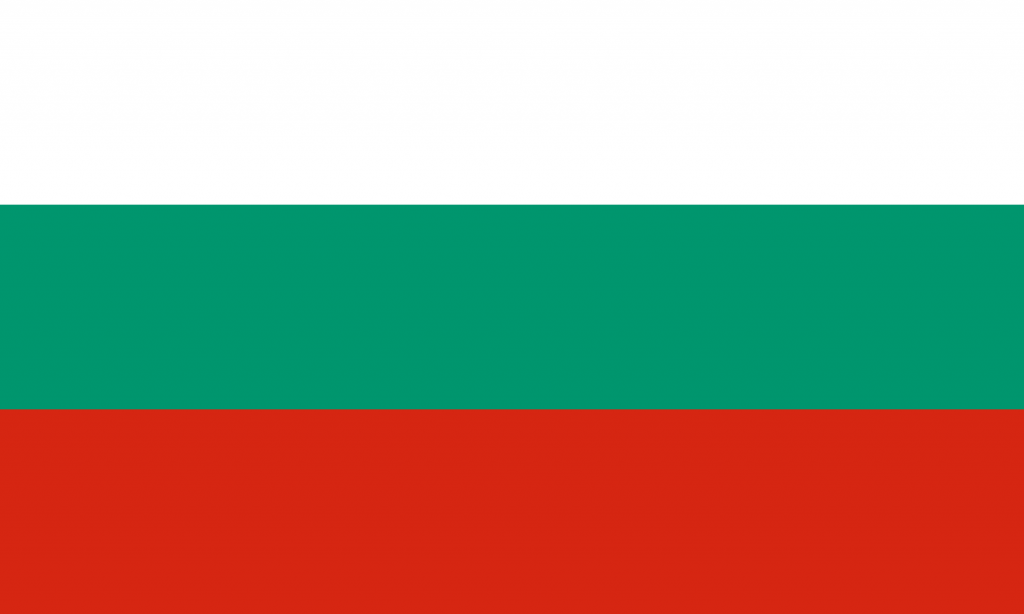
The national flag of the Republic of Bulgaria is a national symbol that expresses the independence and sovereignty of the Bulgarian state.
The national flag of the Republic of Bulgaria is a tricolour: white, green and red fields placed horizontally from the top down. When placing the national flag in a vertical position, the colours are arranged from left to right – white, green, red, as looking at the flag.
The national flag is rectangular. The fields of different colours are uniform in size and are located in a horizontal rectangle.
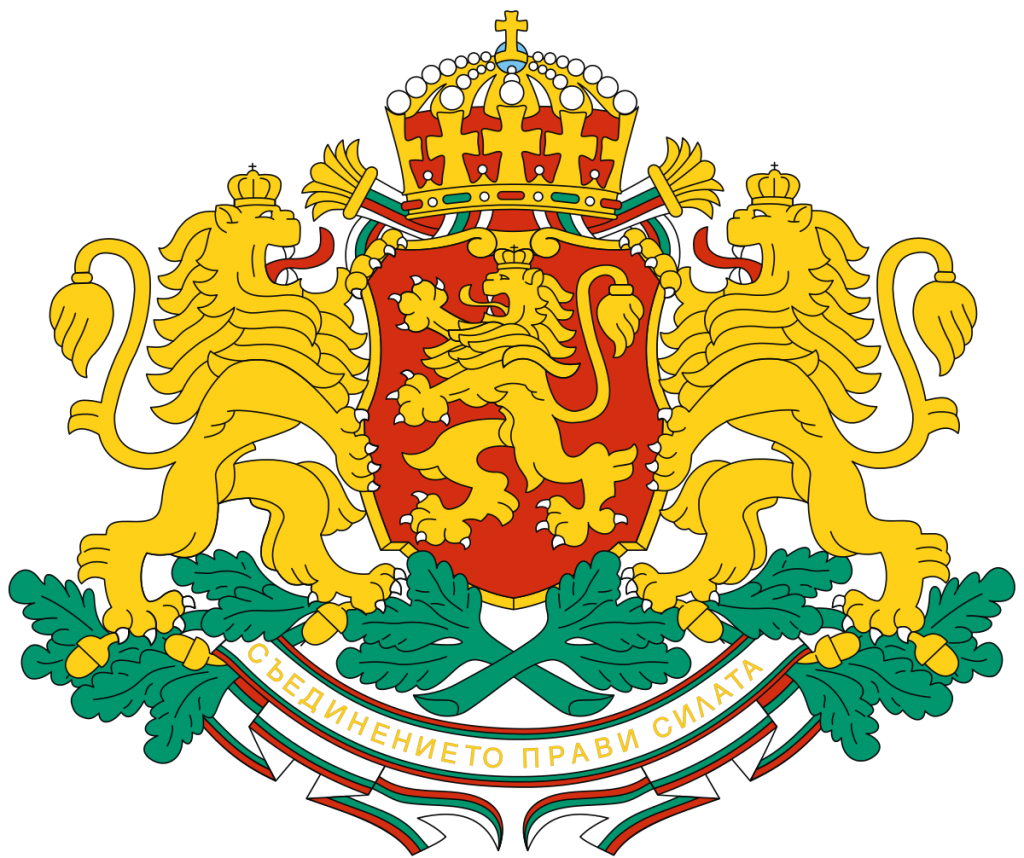
The Coat of Arms of the Republic of Bulgaria is a state symbol expressing the independence and sovereignty of the Bulgarian people and state. It has a rampant gold crowned lion on a dark gules shield. The shield has a crown, a prototype of which was the crown of the Bulgarian kings of the Second Bulgarian Empire, with five crosses and another cross over the crown. The shield is supported by two golden crowned rampant lions, facing the shield from left and right heraldic side.
They stand on two crossed oak branches with acorns. Below the shield across the ends of the oak twigs with three white ribbon edge is written in golden letters “Unity makes strength”.
The National Anthem of the Republic of Bulgaria is the song “Mila Rodino”. The anthem is based on the music and lyrics of the song “Proud Stara Planina” by Tsvetan Radoslavov, written in 1885. “Mila Rodino” became the national anthem of the People’s Republic of Bulgaria in 1964.
With the adoption of the Constitution of the Republic of Bulgaria by the Seventh Grand National Assembly in 1991, “Mila Rodino” established itself as the national anthem of the Republic of Bulgaria.
The President is elected by the Parliament for a 5-year term, with a maximum of two terms. Upon expiration of the presidential term, the Parliament votes to elect a new President.
In Bulgaria, the President’s role is primarily as a symbolic figure, with his main function being to be the ‘arbitrator’ of disputes between Bulgaria’s different institutions. He is not considered head of government or part of the nation’s executive power. The President is elected for a five-year term, which is renewable only once. After an individual has served two terms as President, that individual will forever be barred from being elected the Presidency again under the rules set out by Bulgaria’s Constitution. The President addresses the nation on national television annually on New Year’s Eve, just moments before the start of the new year.
The president of Bulgaria is directly elected for a 5-year term with the right to one re-election. The president serves as the head of state and commander in chief of the armed forces. The President’s main duties are to schedule elections and referendums, represent Bulgaria abroad, conclude international treaties, and head the Consultative Council for National Security. The President may return legislation to the National Assembly for further debate—a kind of veto—but the legislation can be passed again by an absolute majority vote.
The Council of Ministers is the principal organ of the executive branch. It is usually formed by the majority party in Parliament, if one exists, or by the largest party in Parliament along with coalition partners. Chaired by the Prime Minister, it is responsible for carrying out state policy, managing the state budget, and maintaining law and order. The Council must resign if the National Assembly passes a vote of no confidence in the Council or the Prime Minister or rejects a vote of confidence.
The Bulgarian unicameral parliament, the National Assembly or Narodno Sabranie, consists of 240 deputies who are elected for 4-year-terms by popular vote. The votes are for party or coalition lists of candidates for each of the 28 administrative divisions. A party or coalition must garner a minimum of 4% of the vote in order to enter parliament. Parliament is responsible for enactment of laws, approval of the budget, scheduling of presidential elections, selection and dismissal of the prime minister and other ministers, declaration of war, deployment of troops outside of Bulgaria, and ratification of international treaties and agreements.
The Bulgarian judicial system consists of regional, district and appeal courts, as well as a Supreme Court of Cassation and one Specialized Criminal Court. In addition, there is a Supreme Administrative Court and a system of military courts. The Presidents of the Supreme Court of Cassation and the Supreme Administrative Court as well as the Prosecutor General are elected by a qualified majority of two-thirds from all the members of the Supreme Judicial Council and are appointed by the President of the Republic. The Supreme Judicial Council is in charge of the self-administration and organisation of the Judiciary.
A qualified majority of two-thirds of the membership of the Supreme Judicial Council elects the Presidents of the Supreme Court of Cassation and of the Supreme Administrative Court, as well as the Prosecutor General, from among its members; the President of the Republic then appoints those elected.
The Supreme Judicial Council has charge of the self-administration and organization of the Judiciary.
The Constitutional Court of Bulgaria supervises the review of the constitutionality of laws and statutes brought before it, as well as the compliance of these laws with international treaties that the Government has signed. Parliament elects the 12 members of the Constitutional Court by a two-thirds majority. The members serve for a nine-year term.
Administrative divisions of the country (Regional governance, Local Authorities etc.)
The administrative divisions of Bulgaria consist of 2 main levels: the provinces and the municipalities.
The provinces of Bulgaria (Bulgarian: области на България, romanized: oblasti na Bǎlgarija) are the first level administrative subdivisions of the country.
Since 1999, Bulgaria has been divided into 28 provinces (Bulgarian: области – oblasti; singular: област – oblast; also translated as “regions”) which correspond approximately to the 28 districts that existed before 1987.
The provinces do not have official names – legally (in the President’s decree on their constitution), they are not named but only described as “oblast with administrative centre [Noun]” – together with a list of the constituting municipalities. In Bulgaria they are usually called “[Adjective] Oblast”;
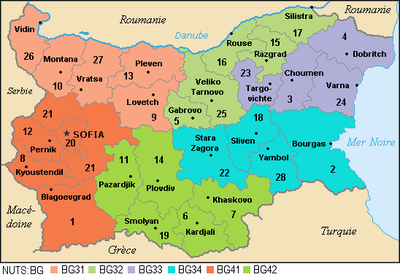
The 28 provinces of Bulgaria are divided into 265 municipalities (община, obshtina). Municipalities typically comprise multiple towns, villages and settlements and are governed by a mayor who is elected by popular majority vote for a four-year term, and a municipal council which is elected using proportional representation for a four-year term. The creation of new municipalities requires that they must be created in a territory with a population of at least 6,000 and created around a designated settlement. They must also be named after the settlement that serves as the territory’s administrative center, among other criteria.
The council of a municipality is further permitted to create admininistrative subdivisions: mayoralties (kmetstvo), settlements (naseleno myasto), and wards or quarters (rayon). Mayoralties are overseen by elected mayors and typically comprises one or more villages or towns; they must contain a population of at least 250.[2] Settlements are overseen by a manager appointed by the mayor of a municipality and thus have fewer responsibilities and less power than a mayoralty; they must have a population of fewer than 150. Wards are overseen by elected mayors and must include a population of at least 25,000; their creation is required in Bulgaria’s three most populous municipalities.