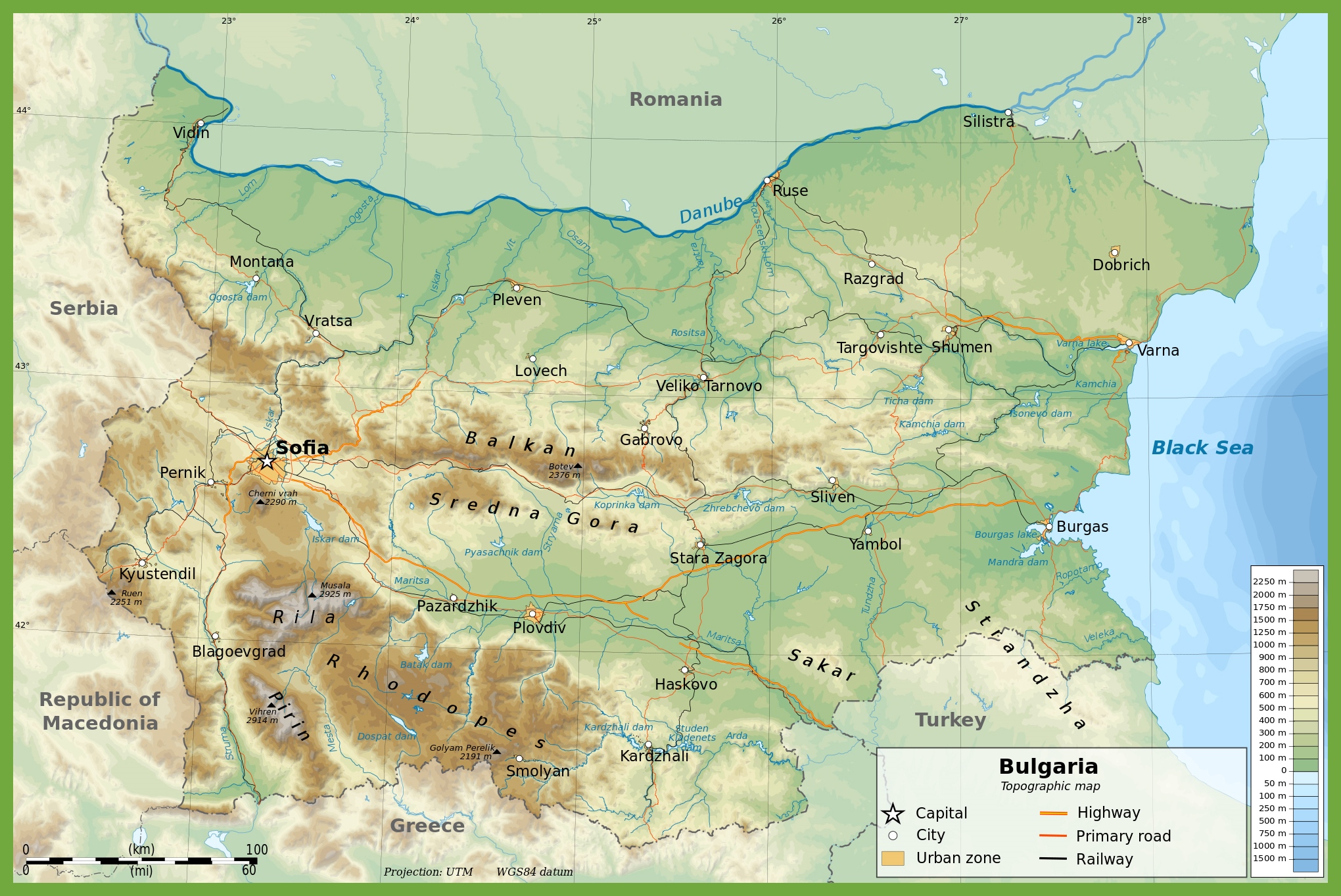
Country location
Bulgaria is a country situated in Southeast Europe and occupies the eastern quarter of the Balkan peninsula, being the largest country within its geographic boundaries.
It is bordering Romania to the north, Serbia and North Macedonia to the west, Greece and Turkey to the south, and the Black Sea to the east. The northern border with Romania follows the river Danube until the city of Silistra.
The land area of Bulgaria is 110,994[1] square kilometres (42,855 sq mi).
Climate
Bulgaria features notable diversity with the landscape ranging from the snow-capped peaks in Rila, Pirin and the Balkan Mountains to the mild and sunny Black Sea coast; from the typically continental Danubian Plain (ancient Moesia) in the north to the strong Mediterranean climatic influence in the valleys of Macedonia and in the lowlands in the southernmost of Thrace, the lowest parts of the Upper Thracian Plain, along the Maritsa River, the Southern Bulgarian Black Sea Coast.
Most of the country is situated within the humid continental climate region, with Alpine climate in the highest mountains and subtropical climate in the southernmost regions.
Bulgaria has a temperate-continental climate with moderate features which is characteristic for Central Europe, with hot summers, long, cold winters and very distinct seasons. Abundant snowfalls may occur throughout the country from December to mid-March, especially if you are in the mountainous areas of Bulgaria.
The annual average temperature depends on latitude and ranges from 8°C in the North and 11°C in the South, with temperatures of 2.6°C in the mountains and 12°C in the plains. In general, the warmest areas are in the southern districts of bulgaria, influenced by the nearby mediterranean sea. Daytime temperatures vary from 0-5°C in the winter and 25-30°C in summer months. In the southern areas it can be warmer, in the northern and eastern mountainous districts of Balkan mountains it can be cooler with moderate daytime temperatures and cool nights in the summer and temperatures far below zero in the winter.
Required clothing:
Lightweights are worn in summer on the coast and in low inland areas. Warmer clothes are needed in winter and throughout the year in the uplands. Rainwear is recommended throughout the year.
Relief
The relief of Bulgaria is varied. In the relatively small territory of the country there are extensive lowlands, plains, hills, low and high mountains, many valleys and deep gorges.
The main characteristic of Bulgaria’s topography is four alternating bands of high and low terrain that extend east to west across the country. From north to south, those bands, called geomorphological regions, are the Danubian Plain, the Balkan Mountains, the Transitional region and the Rilo–Rhodope region.
The easternmost sections near the Black Sea are hilly, but they gradually gain height to the west until the westernmost part of the country is entirely high ground.
Table, showing the distribution of the height zones in Bulgaria:
Height zones | Height (m) | Area (km2) | Area (%) |
Lowlands | 0–200 | 34,858 | 31.42 |
Hills | 200–600 | 45,516 | 41.00 |
Low mountains | 600–1000 | 16,918 | 15.24 |
Medium-high mountains | 1000–1600 | 10,904 | 9.82 |
High mountains | 1600–2925 | 2,798 | 2.52 |
Demographic info
The Resident Population of Bulgaria based on NSI estimates of 31/12/2018 is 7 000 039, of which
3 395 701 male (48,5 %) and 3 604 338 female (51.5 %).
5 159 129 (73,7%) of them live in urban areas.