The Spanish education system from 6-16 is compulsory and for free in the public schools, but we have also private schools and concerted schools that are half private and half public that are less expensive that the private ones.
Spain has become a host country, which must be taken into account, if we wish to promote a multicultural, integrative school system. The Spanish education system offers the following types of education: Infant Education, Primary Education, Compulsory Secondary Education, High School, Vocational Training, Language Studies, Art Studies, Sport Studies, Adult Education, and University Education
Infant school education (from zero to six years) is not compulsory and includes two stages: the first from zero to three years old; and the second from three to six years old. The majority of children start their schooling in the second cycle (between the age of three and six years), which is free of charge in public schools and government-assisted private schools. At this stage, the schools must adopt the relevant measures for students with special educational requirements.
The Primary Education and the Compulsory Secondary Education form part of the basic education which is free in public schools and government-assisted private schools, and compulsory for everyone. The two stages cover ten years of schooling and are normally carried out between the ages of six and sixteen, the minimum legal working age, although the student has the right to remain in the ordinary regime following the basic education system until the age of eighteen in a number of different circumstances: remaining for more than one year in the same school year, joining the Spanish education system at a later age or coming from an education system in another country.
Secondary education is divided into Compulsory Secondary Education and Further Secondary Education. The latter includes the Baccalaureate, Intermediate Vocational Training, Intermediate professional training in Fine Arts and Design and Intermediate Sports Training.
University Education, Higher Arts Education, Higher Level Vocational Training make up the higher education stage.
Lastly, language classes, art and sport education are considered as special education systems. In addition, in Spain, the Autonomous Regions have extensive powers for the development and implementation of the basic national legislation on education, and are able to establish or supplement certain curricular elements depending on the type of subject (content, assessment criteria, assessable learning criteria, etc.), establish their own subjects (“freely definable at regional level”; including, the co-official language and literature in those Autonomous Regions with a co-official language), establish school hours within the limits established under the basic national legislation, etc. In addition, the authority of the Autonomous Regions as regards education covers many areas relating to the creation of education centres, the offer of places and the acceptance of students, the provision of resources, training of teachers, and attention for students with special educational needs, etc. Educational centres in the autonomous regions of Ceuta and Melilla and Spanish education centres abroad are managed directly by the Ministry of Education, Culture and Sport.
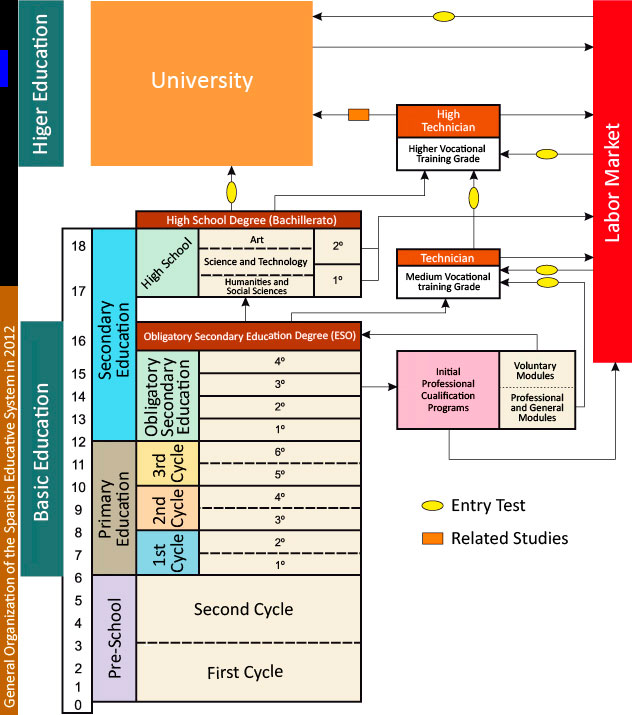
Vocational Training: (formación profesional/FP), traditionally taken by pupils who failed to achieve the standards required to study for the baccalaureate (bachillerato) and long discredited as only for those who aren’t bright enough to pursue an academic career. It has recently been given a higher status in an attempt to foster interaction between educational establishments and the labour market, which is of vital importance to Spain’s economic future. In particular, new vocational training courses have been introduced, enabling successful pupils to take specialist baccalaureate courses and proceed to higher education. Vocational training consists of cycles of between 1,300 and 2,000 teaching hours depending on the profession. The first phase of FP (grado medio) is open to pupils who have been awarded a graduado en educación secundaria certificate (see above) and wish to opt for vocational training rather than study for the baccalaureate. The second phase (grado superior) is open to pupils who have passed the baccalaureate or the examen de prueba de acceso a formación profesional, which includes subjects from the baccalaureate. FP pupils divide their time between school studies and practical on-the-job training in commerce or industry, where they spend about 25 per cent of their learning time. Vocational training is free for most pupils, whether it takes place in a public centre or a private institution, as the latter are financed by the state (but employ their own teachers and have different rules from state centres). In recent years, emphasis has been placed on IT and telecommunications skills and EU languages, particularly English and German. Pupils who complete a grado medio course receive a ‘technical specialist’ (técnico especialista) certificate and those who complete a grado superior course receive a ‘superior technical’ (técnico superior) certificate. Holders of the latter certificate may continue their studies at university.
Foring students: Whether you’re planning a short stay in Spain or will be in the country for an extended period studying, it is essential that you understand the various Visa and entry requirements needed to access legal entry into the country. This information is designed to help you understand the process of obtaining a Visa, if it is needed, and additional information important to your departure to the country. If you are coming to Spain from another country in Europe, a passport or Visa will never be required for entry into the country. If you are coming from a non-European country and plan to stay for a period of three months or longer a passport is required to obtain. The passport must be valid for a period of 90 days after the length of the planned stay in Spain.
The inclusion policy is promoted for all vulnerable groups of student population. Intercultural Education concerns the structuring of relations of different cultural groups with the aim to lift inequality and social exclusion. It sets the framework for harmonious and effective integration in the general education system of students with educational, social and cultural particularities. The objectives of Intercultural Education are pursued by means of the following:
The Spanish National Health System (Spanish: Sistema Nacional de Salud, SNS) is the agglomeration of public healthcare services that has existed in Spain since it was established through and structured by the Ley General de Sanidad (the “General Health Law”) of 1986. The Interterritorial Council of the Spanish National Health Service (Consejo Interterritorial del Servicio Nacional de Salud de España, CISNS) give cohesion to the system and to guarantee the rights of citizens throughout Spain. Article 46 of the Ley General de Sanidad establishes the fundamental characteristics of the SNS: a. Extension of services to the entire population.
The General Health Law of 1986 (Ley 14/1986 General de Sanidad) was formulated on two bases. First, it carries out a mandate of the Spanish Constitution, whose articles 43 and 49 establish the right of all citizens to protection of their health. The law recognizes a right to health services for all citizens and for foreigners resident in Spain.
Second, Title VIII of the Constitution confers upon the autonomous communities broad purview in matters of health and health care. The autonomous communities have first-order importance in this area, and the law permits devolution of these functions from the central government to the autonomous communities, in order to provide a health care system sufficient for the needs of their respective jurisdictions.
The administrative device set up by the law is the National Health System. The presumption underlying the adopted model is that in each autonomous community, authorities are adequately equipped with necessary territorial perspective, so that the benefits of autonomy do not conflict with the needs of management efficiency. The National Health System is thus conceived as the set of health services of the Autonomous Communities properly coordinated.
Thus, the various health services fall under the responsibility of the respective autonomous communities, but also under basic direction and coordination by the central state. The respective health services of the autonomous communities would gradually realize a transfer of health resources from the central government to the autonomous communities.
Under Chapter III of the 1978 Spanish Constitution, all Spanish citizens are beneficiaries of public health services. Concretely, it establishes that:
– Article 39: The public powers assure social, economic and juridical protection of the family.
– Article 43: The right to health protection is recognized. It is the responsibility of public authorities to organize and act as guardian over public health through preventive measures and the provision of necessary services. The Law will establish the rights and duties of all in this respect. The public powers will promote health education, physical education and sports.
– Article 49. The public powers will bring into existence a policy of prevention, treatment, rehabilitation and integration of those with physical, sensory or psychological disabilities.
Further, the Organic Law 4/2000 (Ley Orgánica 4/2000) establishes the rights and liberties of foreigners resident in Spain. Its effect on the healthcare provision can be seen in the following articles:
– Article 3. Foreigners will enjoy in Spain, in equal conditions with the Spanish, the rights and liberties recognized in Title I of the Constitution and in the laws that develop it, in terms established in this Organic Law.
– Article 10. Foreigners will have the right to engage in remunerated activity in self-employment or working for others, such as access to the Social Security System, in terms foreseen in this Organic Law and in the dispositions that develop it.
– Article 12. Foreigners who are registered in Spain in the municipality in which they are habitually resident have the right to health services on the same conditions as the Spanish. Foreigners who are in Spain have the right to urgent health services in the event of contracting severe illness or having an accident, whatever may be the cause, and the continuity of this care until the time of discharge. Foreign minors of less than 18 years who are in Spain have the right to health care on the same conditions as the Spanish. Pregnant foreigners who are in Spain have the right to health care during the pregnancy, while giving birth, and post partum.
Consolidated Text of the Law on the Workers’ Statute
HEADING I: On Individual Labour Relations_ Section 3. Elements and Effectiveness of the Work Contract. Article 6. The Employment of Minors.
Article 7. Capacity to Enter into Contract. The following may enter into work contracts:
Article 8. Form of Contract.